

There are now more than one trillion LEGO bricks on the planet (yes, it’s true, look it up). I wonder what percentage of those bricks are actively played with? Quite a few are stuck on dusty shelves and in bins under the stairs. LEGO bricks are meant to be played with, and anything that can (re)activate bricks is great in my book. That’s one of the reasons to be excited about the 2×4-sized smart brick. Part of a system, but also something truly new.
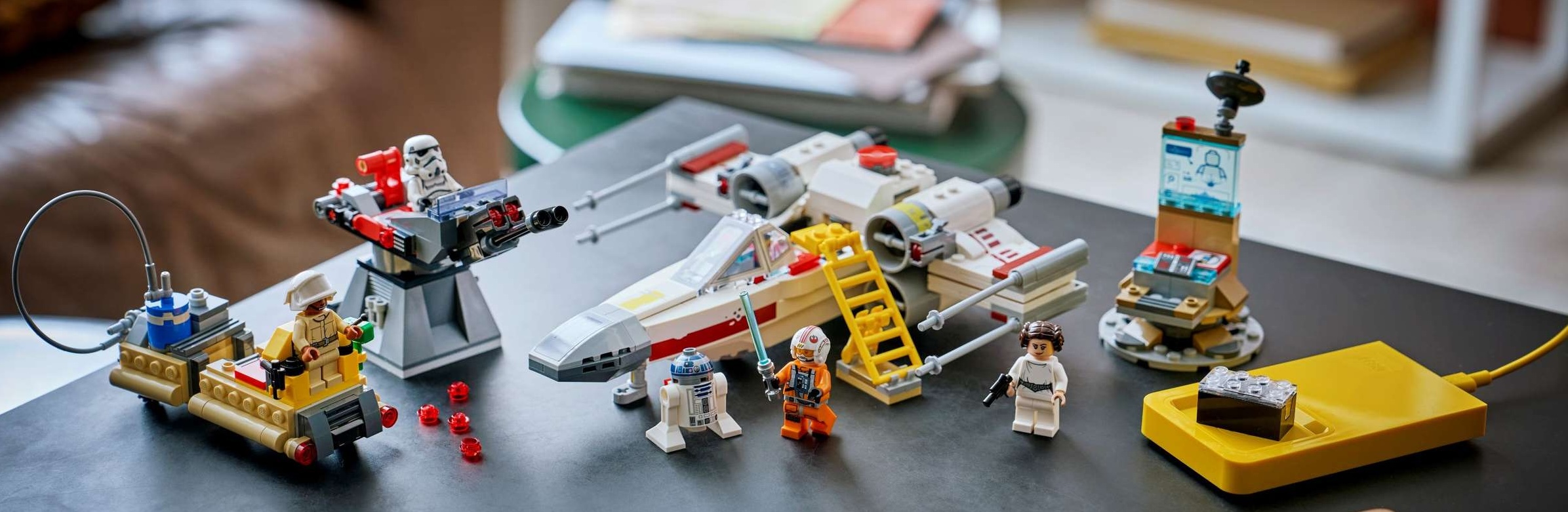
Looking at that X-Wing fighter makes me happy. It seems like a really fun and robust toy to be played with. A model that can be swooshed around and smaller minibuilds + characters. Tons of opportunities for free play and roleplaying, a microworld. And every part is exposed and playable, as opposed to all the so-called ‘smart toys’ which are often a kind of black box with some tech inside (and no longevity). I like all the mechanical, kinetic builds and tricks used to activate the smart brick in the Star Wars sets. The smart brick has to be physically moved to activate, and that is both banal and profound. It feels both novel and old school LEGO at the same time. I very much like that there are no screens involved. I once said (half-jokingly) that augmented reality play is great for all kids with three arms: two for playing and one to hold the phone. My thing is open-ended physical play, and it feels like the smart brick will support that well.
The smart mini figures are speaking a gibberish language similar to the one in the LEGO computer games. Would the product be better if it could produce perfect audio samples from the Star Wars movies? I would say a big no. I think the product has about the same resolution as LEGO bricks. A LEGO X-wing is not a perfect replica of the craft seen in the movie either; it has a different resolution and can, of course, be broken down into small pieces. Much of the critique of the LEGO smart brick sounds to me quite similar to the time when people were complaining about there being too many special LEGO pieces. That critique has pretty much gone away, but it was also quite silly back in the day. To this day, you are most welcome to buy a big box of classic 2 x 4 LEGO bricks; you can even build a Star Wars X-Wing out of those bricks. It will be clunky and in a different resolution, but no one is stopping people from doing this. Same goes for the smart brick. And the current sets are targeted at kids from 6 to 9 years old, so perhaps also let them have a go and decide? That is not to say that the brick will automatically be a success in the market, far from it. But I’m confident that the smart brick will stay around for a long time if the economics behind it make sense. Of course, if LEGO is losing money on each set and if the smart brick does not result in increased sales of traditional bricks and engagement, then it will be killed off eventually to make shelf space for more profitable products. But I could see a market for more creative, interactive toys. The majority of the so-called smart toys are incredibly bad, with no real longevity or lasting play value.
The platform and the tech, as they stand now, are surprisingly close to the concept presented to the team I was part of some five years ago. Impressive! I can easily imagine the many prototypes, pivots, compromises, Teams meetings, and long days along the way. But the core concept is intact, including the positioning system, as described in the “Saved by the bell” section of this behind-the-scenes story. I have absolutely no insider insights into this, but I’m guessing that the smart brick roadmap is long and wide, and I sincerely hope LEGO has the patience to let the system unfold over a long period of time.
Godtfred Kirk Christiansen (creator of the original LEGO brick) was known to go down on his knees in product meetings, literally, in order to see (and try) the prototypes from a child’s perspective. This is still sound advice and worth remembering. To me thay is still the core LEGO experience. Godtfred would probably have liked smart bricks (perhaps initially sceptical, but I’m guessing he would have been amazed by the new, old 2×4 smart brick. Star Wars probably not so much – he was not so big on “battle play” 🙂
My first boss at LEGO, Jens Nygaard Knudsen (inventor of the minifigure), once remarked that lights were more important than sound, because kids could make their own sounds while playing with LEGO – but kids can’t do lights. I’ve always thought that was both hilarious and true. So back in the 80s we had the 9V Light & Sound system, and I designed a LEGO Space Police set (6781) that only had blinking lights, no sound (that sound brick was incredibly expensive). I’m sure kids will continue to supplement the smart brick sounds with their own. And I also strongly suspect that Jens too would have loved the smart brick if he were still here.
It was the first project for me where remote work was not just an option, but necessary (there was some COVID around at the time). It was also an a-ha moment for me to see how well that worked – most of the time probably more effective than being in the same room. Such a great team, full of talented people who could execute quickly. Sometimes we would literally start with a blank slate on Monday morning and end up with a working prototype to play with on Friday. It was great, and sometime I miss being part of a team like that.
For me personally, it was a huge pleasure to build actual, physical LEGO models again — lots of fun. I did a few runs to the local Føtex to get bricks (at the time it was faster than going to locked-down Billund), but I also took a deep dive into my own vault for materials. So some of those model prototypes literally contain elements from my childhood (and my kids’ childhood as well). Not many products in the world can do something like that. The system works.
Note: I haven’t yet played with the final products, but I’m hoping to do so before too long.

 ...
... 