
Winter/Summer


A few thoughts on the LEGO Smart Brick

There are now more than one trillion LEGO bricks on the planet (yes, it’s true, look it up). I wonder what percentage of those bricks are actively played with? Quite a few are stuck on dusty shelves and in bins under the stairs. LEGO bricks are meant to be played with, and anything that can (re)activate bricks is great in my book. That’s one of the reasons to be excited about the 2×4-sized smart brick. Part of a system, but also something truly new.

Looking at that X-Wing fighter makes me happy. It seems like a really fun and robust toy to be played with. A model that can be swooshed around and smaller minibuilds + characters. Tons of opportunities for free play and roleplaying, a microworld. And every part is exposed and playable, as opposed to all the so-called ‘smart toys’ which are often a kind of black box with some tech inside (and no longevity). I like all the mechanical, kinetic builds and tricks used to activate the smart brick in the Star Wars sets. The smart brick has to be physically moved to activate, and that is both banal and profound. It feels both novel and old school LEGO at the same time. I very much like that there are no screens involved. I once said (half-jokingly) that augmented reality play is great for all kids with three arms: two for playing and one to hold the phone. My thing is open-ended physical play, and it feels like the smart brick will support that well.
The smart mini figures are speaking a gibberish language similar to the one in the LEGO computer games. Would the product be better if it could produce perfect audio samples from the Star Wars movies? I would say a big no. I think the product has about the same resolution as LEGO bricks. A LEGO X-wing is not a perfect replica of the craft seen in the movie either; it has a different resolution and can, of course, be broken down into small pieces. Much of the critique of the LEGO smart brick sounds to me quite similar to the time when people were complaining about there being too many special LEGO pieces. That critique has pretty much gone away, but it was also quite silly back in the day. To this day, you are most welcome to buy a big box of classic 2 x 4 LEGO bricks; you can even build a Star Wars X-Wing out of those bricks. It will be clunky and in a different resolution, but no one is stopping people from doing this. Same goes for the smart brick. And the current sets are targeted at kids from 6 to 9 years old, so perhaps also let them have a go and decide? That is not to say that the brick will automatically be a success in the market, far from it. But I’m confident that the smart brick will stay around for a long time if the economics behind it make sense. Of course, if LEGO is losing money on each set and if the smart brick does not result in increased sales of traditional bricks and engagement, then it will be killed off eventually to make shelf space for more profitable products. But I could see a market for more creative, interactive toys. The majority of the so-called smart toys are incredibly bad, with no real longevity or lasting play value.
The platform and the tech, as they stand now, are surprisingly close to the concept presented to the team I was part of some five years ago. Impressive! I can easily imagine the many prototypes, pivots, compromises, Teams meetings, and long days along the way. But the core concept is intact, including the positioning system, as described in the “Saved by the bell” section of this behind-the-scenes story. I have absolutely no insider insights into this, but I’m guessing that the smart brick roadmap is long and wide, and I sincerely hope LEGO has the patience to let the system unfold over a long period of time.
Godtfred Kirk Christiansen (creator of the original LEGO brick) was known to go down on his knees in product meetings, literally, in order to see (and try) the prototypes from a child’s perspective. This is still sound advice and worth remembering. To me thay is still the core LEGO experience. Godtfred would probably have liked smart bricks (perhaps initially sceptical, but I’m guessing he would have been amazed by the new, old 2×4 smart brick. Star Wars probably not so much – he was not so big on “battle play” 🙂
My first boss at LEGO, Jens Nygaard Knudsen (inventor of the minifigure), once remarked that lights were more important than sound, because kids could make their own sounds while playing with LEGO – but kids can’t do lights. I’ve always thought that was both hilarious and true. So back in the 80s we had the 9V Light & Sound system, and I designed a LEGO Space Police set (6781) that only had blinking lights, no sound (that sound brick was incredibly expensive). I’m sure kids will continue to supplement the smart brick sounds with their own. And I also strongly suspect that Jens too would have loved the smart brick if he were still here.
It was the first project for me where remote work was not just an option, but necessary (there was some COVID around at the time). It was also an a-ha moment for me to see how well that worked – most of the time probably more effective than being in the same room. Such a great team, full of talented people who could execute quickly. Sometimes we would literally start with a blank slate on Monday morning and end up with a working prototype to play with on Friday. It was great, and sometime I miss being part of a team like that.
For me personally, it was a huge pleasure to build actual, physical LEGO models again — lots of fun. I did a few runs to the local Føtex to get bricks (at the time it was faster than going to locked-down Billund), but I also took a deep dive into my own vault for materials. So some of those model prototypes literally contain elements from my childhood (and my kids’ childhood as well). Not many products in the world can do something like that. The system works.
Note: I haven’t yet played with the final products, but I’m hoping to do so before too long.
Blackstar

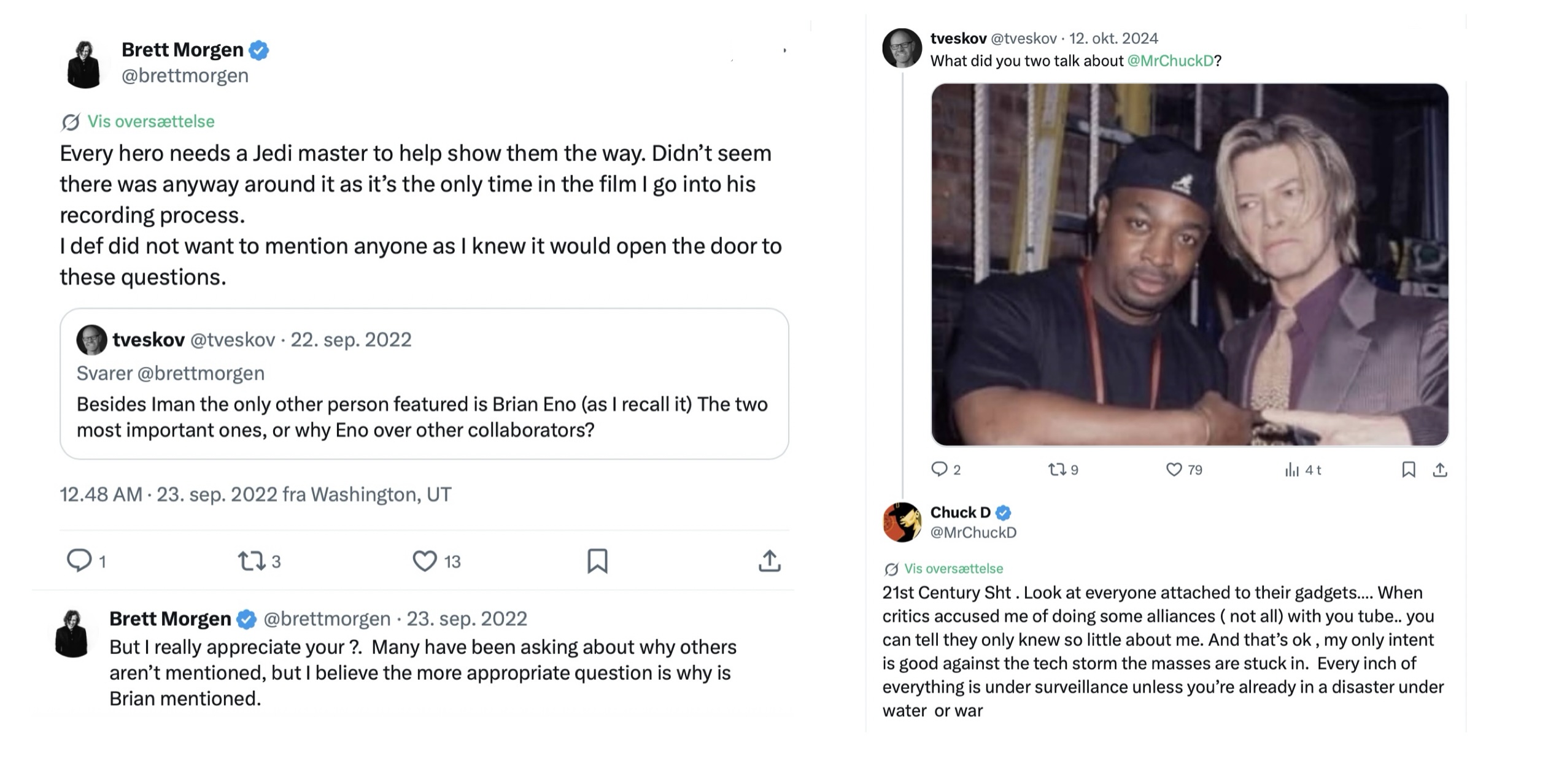
David Bowie died on this day ten years ago, so I watched my favorite music ‘documentary’ once again. It is Moonage Daydream by Brett Morgen, and it is brilliant. Such a dense piece of visual art and storytelling, extremely multifaceted and complex, like Bowie. It took five years to make in total and two years to edit, and it is easy to see why. I also watched the new documentary ‘Bowie: The Final Act,’ and it was good. (If you are in Denmark, watch it here). Also, check out Bowie Bible, what a website (yes, those are still around). And ‘David Bowie – The Last Five Years’ is free to watch on YouTube, recommended.
“At the turn of the 20th century, Friedrich Nietzsche proclaimed that God is dead and that man had killed him. This created an arrogance with man that he himself was God. But as God, all he could seem to produce was disaster. That led to a terrifying confusion: for if we could not take the place of God, how could we fill the space we had created within ourselves?”
David Bowie, 2002
Moonage Daydream starts with this quote which leads into this monologue about the nature of time.
There were many things to like about David Bowie besides the music; he loved art and knew a lot about it, was an okay painter himself, read a lot of books, and last but not least, he had a great sense of humor. Some saw him as somewhat distanced and cold person, but he was often very funny in interviews and seemed to enjoy a good laugh at the absurdity of fame, life, and death.
A favorite moment; Bowie covers Simon & Garfunkel’s “America” for the post 9/11 benefit concert in October 2001. He was a resident of NYC at the time, and it seems to me that he dialed up his english accent, perhaps to empasize the city’s international/immigration vibe. Enjoy this simple performance.
Joy in Repetition
I enjoy taking long walks in novel locations, but what I enjoy even more is my daily walk, which is pretty much the same every day. Or rather always as never before. You cannot step in the same river twice, and the daily walk will always be slightly different even if the route is the same; weather, mood, light, and seasons will change. A good time for thinking, a meditation. So much of life is waves, repetition, routines. It’s all good, as long as joy is part of it. Like a child who laughs 20 times in a row when playing peek-a-boo, or as Prince sang, ‘The song’s a year long and had been playing for months when he walked into the place,’ and where the singer in the song only repeats ‘Love me’ infinitely.
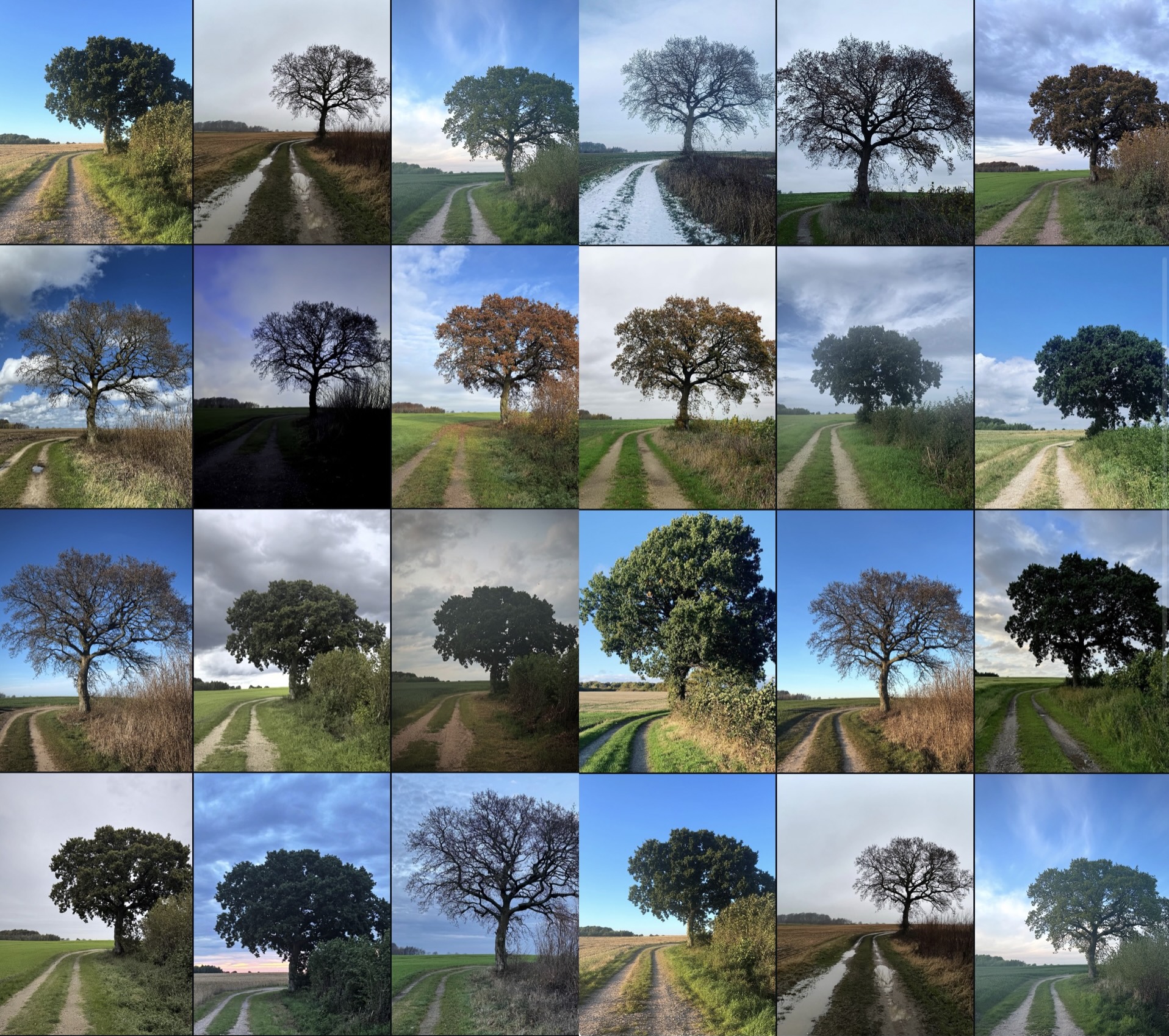
The world outside my window
Yeah, this a color photo.

Where AI is going
AI has become a Rorschach test of sorts; you can tell a lot about a person from their general thoughts and stance on the topic. As with, e.g., social media, it is a complex and complicated thing to grasp, developing and changing constantly, impossible to pin down as either ‘good’ or ‘bad’. Both AI and SoMe are multidimensional issues, and both can accelerate, distort, and enhance all things that were already in the world, good and bad. But it is clear that the outer extremes for AI are much more radical compared to the effects of SoMe, from ‘existential threat’ on one side to ‘work-free abundant nirvana’ on the other. Some people use AI to become dumber at an alarming rate; other people that were already smart seem to use AI almost as a newfound superpower (although we are still waiting for the first one-person billion-dollar company to arrive, I think?). And the smartest people I know have very different takes on where AI is going. No one knows. But I would warmly recommend listening to ‘The Last Invention podcast’ for nuanced and insightful takes on AI and where we are headed; I have been through all the episodes; it’s really good. (Find it on YouTube, Spotify, or Apple Podcasts).
Liv Boeree acts it out..
Also, check out ‘The Thinking Game,’ an award-winning documentary about the rapid rise of AI and the possible road towards AGI, featuring DeepMind and the company’s co-founder Demis Hassabis, who I think is fair to call a genius. His first computer was a ZX Spectrum (Yay!), and he grew up with games and gaming (he worked as a game designer at a young age; this article tells that story and more). The movie documents the journey from early attempts to play simple Atari video games on to AlphaGo, AlphaFold, and beyond. One interesting point from the movie: Hassabis insisted that the company should stay in London as he saw a lot of untapped European AI talent. The obvious thing to do would be to relocate to Silicon Valley, but no. The movie presents a somewhat one-sided and probably too positive outlook (no mention of Geoffrey Hinton, OpenAI, and all that took place in parallel to DeepMind’s work). But well worth a watch, and can do that right here: (or see more posts on AI here)
Sundown




LHF: Ask better follow-up questions
The easiest way to have better conversations is simply to ask more questions. Be a little more curious and present, try to listen a bit more (two ears, one mouth and all that). Perhaps we are seeing a side effect of online communication where everything is about the next thing. And of course, it is tempting to quickly follow up on a point by relating it to something you have experienced yourself. Nothing wrong with that, it’s how we connect the dots. But try to acknowledge what the other person is saying by asking a follow-up question or two. Otherwise, the conversation can easily turn into a tedious back-and-forth of “Enough about you, let’s talk about me” affair. When you feel seen, heard and perhaps even understood, you are also much more likely to share more, and the conversation becomes deeper. I am trying to become better at this myself; it is mostly about being aware and just being a little bit curious. That’s it, really.
Oh, and LHF is ‘Low Hanging Fruits,” just super simple little things you can try.
The moon
John Davies Cale / Jack L Kerouac
The moon her magic be, big sad face
Of infinity
An illuminated clay ball
Manifesting many gentlemanly remarks
She kicks a star, clouds forgather
In Scimitar shape, to round her cradle out
Upside down any old time
You can also let the moon fool you
With imaginary orange-balls
Of blazing imaginary light in fright
As eyeballs, hurt and forgathered
Wink to the wince of the seeing
Of a little sprightly otay
Which projects spikes of light
Out the round smooth blue balloon ball
Full of mountains and moons
Deep as the ocean, high as the moon
Low as the lowliest river lagoon
Fish in the tar and pull in the Spar
Billy the Bud and Hanshan Emperor
And all wall moon gazers since Daniel Machree
Yeats see
Gaze at the moon ocean marking the face
In some cases, the moon is you
In any case, the moon
Listen to it here

Stranger Things
I have been know to use Apple Keynote for things it’s not supposed to do. Strange things. And because of Season 5 of the Netflix series, here’s an old attempt at doing the intro in four keynote slides. It was simple enough to get 90% of the way, but (as so often before) the last 10% of a thing often takes 90% the effort (the timing being the main challenge here).
 ...
... 